Full Disclosure: I work in the outdoor industry and get very generous discounts (30-70%off) from my employer and also have access to industry “pro-deals” (40-80% off) directly from manufacturers or through aggregator websites. That said, even with these opportunities open to me I still follow the same methodology when I choose outdoor apparel and gear.
Philosophizing about the different kinds of “value” is fine, but this is the real world both travel and gear cost real money and that’s why most people think in monetary terms when they hear “value.” Just as I have no business telling you that there is a “right way” to travel I also have no business telling you how much to spend your money. All I can suggest is that you take the same approach to questions of “cost” as I have advocated that you do to the question of “value.” Whether you spend a little or a lot here is my only piece of advice:
- Buy the best, most versatile items you can, while staying within your budget.
This goes for anything from your plane ticket, to your lodging, to your pack and clothing. How much is it worth to you to skip a direct flight in favor of a 3 hour stop over along the way? Do you value the efficiency and ease of the non-stop over the possibility of saving enough money to add an extra day to the length of your vacation? There’s no right answer, but you should consider the question if only to determine what you value (in every sense) when you travel.
I will always advocate that you buy the best you can afford because, generally speaking, you do get what you pay for. I’ll have more to say in other places on the site, but let me give you a concrete example by using a basic piece of gear that every traveler needs- a reliable rainshell.
You might think that you can’t afford the kind of gear you need (or want), but with time and patience you can probably find a way without spending “full retail” for your gear. Here are a few ways you can get your hands on the good stuff without breaking your budget. I’m going to use rain shells as an example, but this could apply to just about any good or service involved in ultralight travel on a budget.
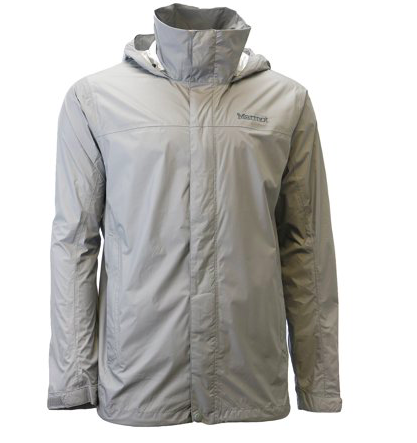
First, you need to have a budget but that budget needs to be flexible- within reason. Let’s say you need a new rain shell and you budget $100 for it. For that price you could get a new Marmot “Pre-Cip” jacket (or a similar North Face “Venture 2”) a jacket generally considered to be about the best value for money in its category, though not “the best” rain shell there is. Still, for $100 you’d be getting a good value. However, you could probably pick up a “past season” model for about $50 if you’re not to picky about the color. But, it’s also true that with a little shopping around on the discount sites and maybe skipping one restaurant meal on your trip you could increase your budget to $125-150 and get something like the Marmot “Magus” jacket, which gets you a more durable jacket that stretches, has waterproof zippers, and an additional pocket.

Second, put in the time, i.e., do your research! The internet is your friend when it comes to this. Do you know exactly what you want right down to the make, model, color, etc.? Great, go to the brand’s website, see how much it is, and then don’t buy it- even if it’s on sale! Use that price as your baseline- you may end up buying from the brand’s site in the end, but do a thorough search online for a better price first. This could be as simple as using the shopping function on Google or it could require you to endlessly scroll through sites like Mountain Steals, Steep & Cheap, Campsaver, REI’s Garage/Outlet, etc. in order score the kind of deal that will make you happy for days!
Third, expand your horizons. The big brands- North Face, Patagonia, Marmot, etc.- make some great gear and are easy to find, but in terms of value for money you can often do better- a lot better. Just as an example, I’ve never owned a single piece of clothing or gear from the North Face, not because of quality, but because I’ve always been able to find something similar for less or something better for the same price- or both! If you look at a lot of reviews, “best of” lists, etc you’ll see names of “mid-sized” companies like Black Diamond, Outdoor Research,etc. and there is a reason for this: These companies have remained focused on their key business, while companies like the North Face (and Patagonia to an extent) have expanded into the “lifestyle” segment of the market- sometimes to the detriment of their core businesses.
Fourth, don’t discount “mass market” or “house” brands. Columbia might seem like a brand that only makes boring “dad fleeces,” but the fact is that, in addition to churning out thousands of forgetable midweight fleeces, they also make some really good, well-priced gear. Their gear might be a bit heavier and they might rely more on in-house versions of leading edge technology (Gore-Tex Pro, Polartec NeoShell, etc.), but they can also be a good place to “dip your toe in” if you’re just getting started in ultralight budget travel or just have a really tight budget and need a reliable, if not feature-rich piece of clothing. Also consider, the “house” brands at places like REI or EMS. Generally speaking you’re going to have to make some sacrifices (weight, features, etc.) to get the cheaper prices available from these retailers, so it’s up to you to decide whether the trade-off works for you. If I’m honest, companies like this- especially REI- have spent decades trying to find the “sweet spot” where price and quality/features meet and it shows in the fact that many of their products- especially tents, sleeping bags, backpacks, and outerwear- show up as a “best value” when the year end reviews are released.
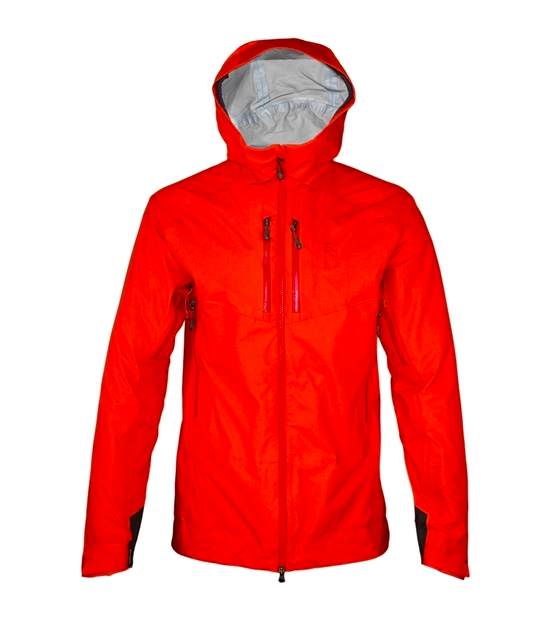
If you do enough research you’re also going to come across another group of manufacturers, sometimes called “boutique,” “niche,” or “cottage” brands. I am a big fan of the clothing made by Brooks Range Mountaineering. Brooks Range were (they closed at the end of 2018)* a small company in Northern California that focused on making clothing and gear for avalanche forecasters, search and rescue personnel, ski patrols, etc.. Their gear wasn’t cheap (though even at full price it was cheaper than the equivalent gear from companies like Arc Teryx, Westcomb, etc.), but it was impeccably made and super durable. My current hardshell jacket is a Brooks Range “Armor” jacket (below) that I paid $149 for- 30% of its origial retail price- when the company when out of business. It’s an XL when a L probably would have been a bitter fit, but at that price…
Even at full price this jacket would be a decent value- other manufacturers using Polartec NeoShell (the most breathable waterproof fabric currently available) start their offerings at around $400. To give you a good comparison, this jacket was a replacement for an Arc’Teryx Alpah SV (currently retailing for $800) that lasted me for a decade of HARD use. If the Brooks Range lasts for even half that time I will have gotten great value out of it. I have nothing against the “big” or “expensive” brands…except their lack of value in a lot of cases. I own an Arc Teryx soft shell and vest, a Mountain hardwear fleece, I used to have a Patagonia day pack, etc. I even own some clothing from the notoriously overpriced outfitter Filson. All of these have been great products, but in all cases I paid 50% (or less!) for them, thus creating the value I don’t normally see in these brands.
So, whether it’s a rain shell or a bed & breakfast, determine what you need, do your research, and spend your money wisely.
*there is a “Brooks Range Mountaineering” site back online which has lifted some of the text from the original site but is actually just full of links to gear on Amazon that is about 99% stuff you should not buy- BEWARE!
 Granite Glen Ultralight